The study investigated whether immune cells originating in bone marrow enter the human brain during normal aging.
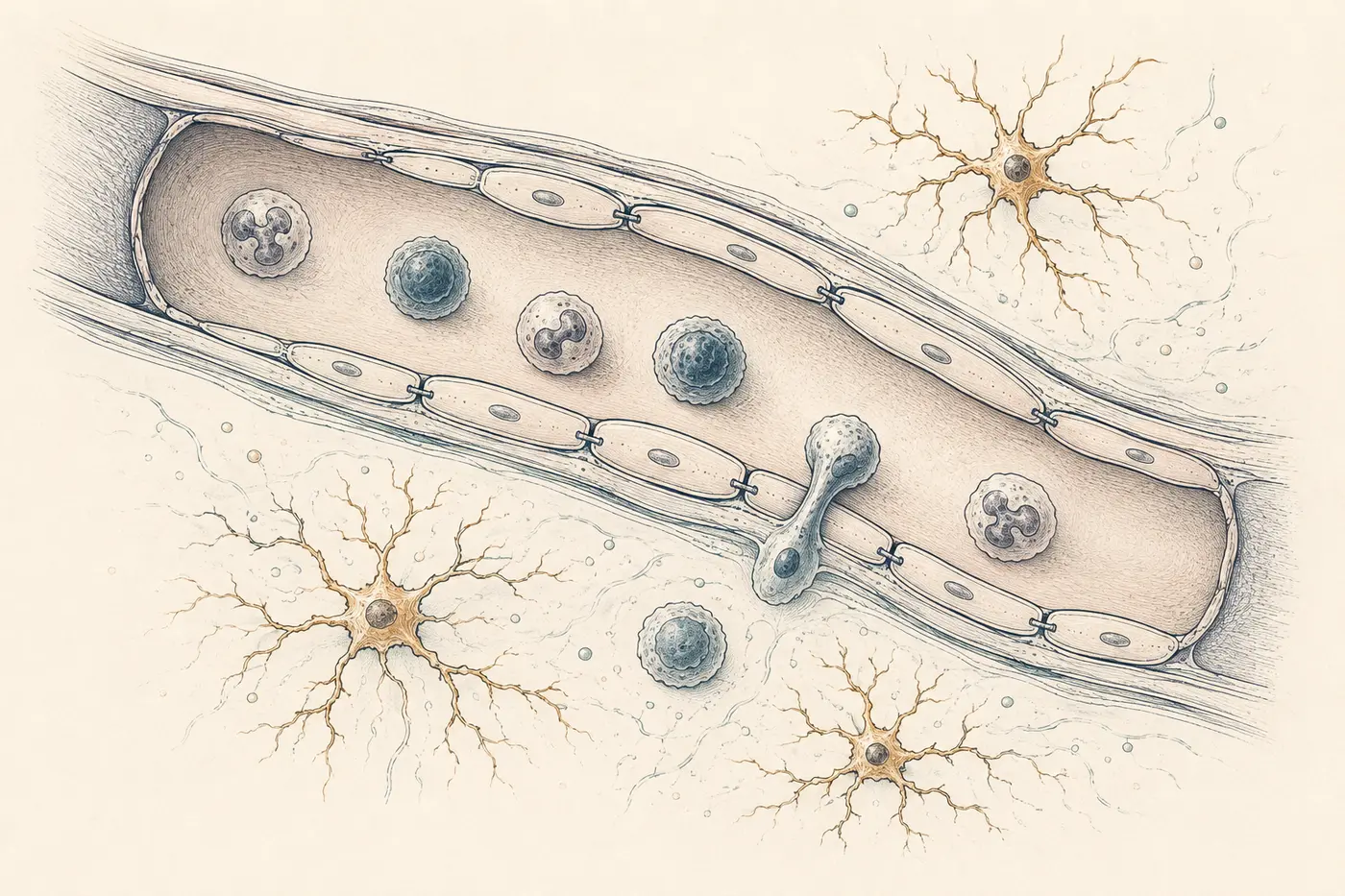
A conceptual view of peripheral immune cells crossing a small brain blood vessel, with resident immune cells in the surrounding tissue.
Reading boundary: The illustration explains the proposed cellular setting. It does not show that the entering cells cause dementia or that every aging brain changes in the same way.The research question and why it matters
The study investigated whether immune cells originating in bone marrow enter the human brain during normal aging.
The brain was once treated as largely immune-isolated, but barrier and microglial research has shown active communication with peripheral immunity.
What the researchers needed to distinguish: whether the reported pattern or intervention could be demonstrated with the stated design and measurements—not whether every broader explanation or future application was already established.
What researchers found
Bone-marrow-derived immune cells were detected in aging brains, with patterns suggesting increased entry across the blood-brain barrier.
The safest conclusion is limited to the research subject (human), the design (human tissue and single-cell analysis) and the measured evidence base described above. Broader claims require additional studies that test different populations, settings, methods or assumptions.
How the research worked
Researchers analyzed human brain tissue with cellular and genetic tools that distinguish resident microglia from cells originating elsewhere in the body.
How to interpret this design
The design determines what kind of conclusion the evidence can support. Direct measurement strengthens the reported observation, while generalization beyond the tested subjects, material, place or conditions requires additional evidence.
The reported evidence base was Human brain tissue across ages, with cell-origin analyses. Sample size matters, but it must be read together with who was included, how outcomes were measured, missing data, comparison conditions and the size of the observed effect.
Because the research involved people, it speaks directly to the participants and outcomes measured. It may still apply differently to people outside the eligibility criteria, age range, clinical setting, geography or follow-up period.
How strong is the evidence?
Multiple molecular methods support the presence and origin of cells in human tissue, but postmortem analysis cannot show their effects over time.
The result is meaningfully informative, but identifiable limitations could alter the size, reach or causal interpretation of the finding.
Funding and disclosure context
The recorded funding source is: NIH-supported research; see the paper. The recorded conflict information is: See the paper. Funding or a disclosed relationship does not by itself invalidate a result, but it is relevant when judging design choices, analysis and the need for independent replication.
What it means
The finding revises a simple view of brain immune isolation and identifies peripheral immune entry as a possible contributor to aging biology.
The finding is most useful when kept at the scale actually tested. It may change how researchers frame the next experiment, trial, observation or analysis even when it is not yet sufficient to change practice or establish a universal explanation.
What it does NOT prove
- It does not show that the cells cause dementia.
- It does not show that blocking cell entry would improve brain health.
- It does not establish the timing of entry in living people.
Important limitations
- Postmortem tissue offers snapshots rather than longitudinal change.
- Donor health and end-of-life conditions may influence tissue.
- Cell presence does not establish harmful or beneficial function.
How this fits with previous research
The brain was once treated as largely immune-isolated, but barrier and microglial research has shown active communication with peripheral immunity.
Consistency with earlier work can increase confidence, while a disagreement can expose a difference in population, measurement, model assumptions or study quality. Either way, one publication should be interpreted as part of a developing evidence record rather than as the final word.
Questions still unanswered
- What signals permit entry?
- Are the cells protective, harmful or context-dependent?
- Do neurodegenerative diseases change the process?
Relevant U.S. government resources
These resources serve different purposes. A registry can verify what researchers planned, a repository can locate government-funded work, and an agency page can supply authoritative background. None automatically proves that this paper's conclusion is correct.
PubMed record search ↗
Federal biomedical-index search keyed to this paper's DOI or title. It can confirm indexing and expose linked identifiers when a record is available; the journal paper remains the primary source.
Understanding clinical research ↗
NIH background on how clinical research is designed, reviewed and interpreted. This is contextual guidance, not independent confirmation of the study's result.
Reuse note: Facts and discoveries are summarized here in original language. We link to government material instead of copying it wholesale, and we do not reuse agency logos, photographs, charts or third-party material unless the specific reuse rights are verified.
Bone-marrow immune cells were found crossing into the aging human brain
This review was developed from the source record below and, when separately available, the primary paper or government report. The summary and analysis on this page are original editorial writing.
- Source organization
- NIH Research Matters
- Source type
- U.S. government
- Authors
- Authors listed in the Nature paper
- Journal / report
- Nature
- Publication date
- August 11, 2026
- DOI
- 10.1038/s41586-026-10939-0
- PMID
- 42239322
- Institution
- Institutions listed in the paper
- Funding
- NIH-supported research; see the paper
- Conflicts
- See the paper
- Open access
- Unclear
- Reuse approach
- Facts summarized in original language; no source text or imagery reproduced.