The analysis asked how different intervention timing and effectiveness assumptions might alter the course of an Ebola outbreak.
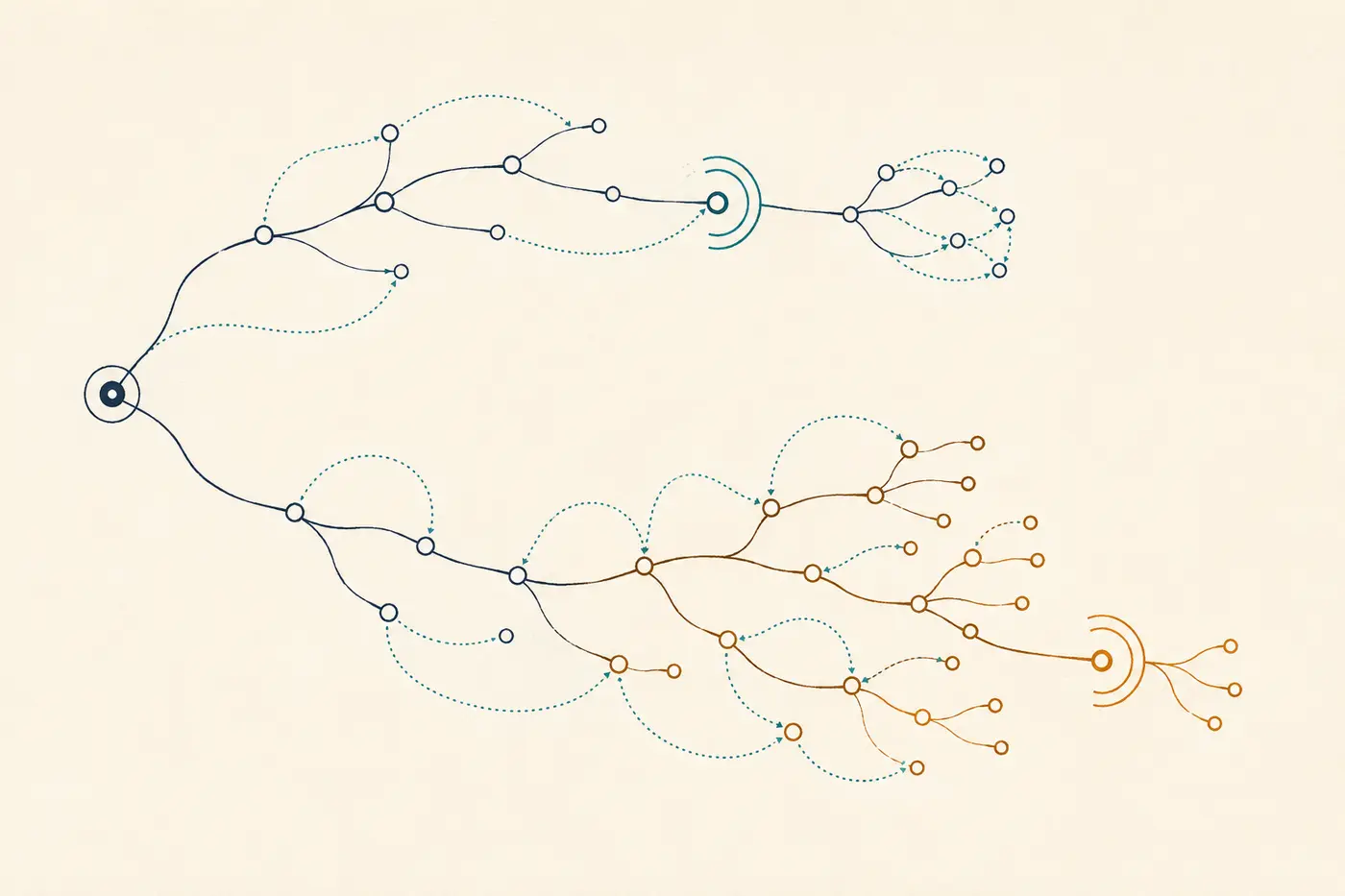
A conceptual view of how the timing of case detection, contact tracing and isolation can change an outbreak trajectory in a scenario model.
Reading boundary: This is not a forecast, patient map or measured transmission chain. The real-world result depends on local conditions and the assumptions entered into the model.The research question and why it matters
The analysis asked how different intervention timing and effectiveness assumptions might alter the course of an Ebola outbreak.
Earlier Ebola models have likewise shown that case isolation, contact tracing and safe care practices are time-sensitive.
What the researchers needed to distinguish: whether the reported pattern or intervention could be demonstrated with the stated design and measurements—not whether every broader explanation or future application was already established.
What researchers found
Stronger, earlier control scenarios produced smaller modeled outbreaks than delayed or weaker responses.
The safest conclusion is limited to the research subject (computer model), the design (infectious-disease scenario model) and the measured evidence base described above. Broader claims require additional studies that test different populations, settings, methods or assumptions.
How the research worked
Researchers simulated transmission under alternative control scenarios and compared projected outbreak trajectories rather than observing a randomized intervention.
How to interpret this design
The result is conditional on the model structure, inputs, boundary conditions and scenarios chosen by the researchers. Agreement with known observations strengthens confidence, but a projection is not a direct observation of the future or the inaccessible past.
The reported evidence base was Simulated outbreak trajectories under multiple response assumptions. Sample size matters, but it must be read together with who was included, how outcomes were measured, missing data, comparison conditions and the size of the observed effect.
The evidence is produced by computation rather than direct experimental manipulation of the target system. Its value depends on transparent assumptions, realistic inputs, sensitivity testing and comparison with independent observations.
How strong is the evidence?
Scenario models are useful for comparing intervention timing, but their numerical results depend on uncertain transmission and response assumptions.
The result explores a plausible explanation or scenario. Its reliability is conditional on assumptions and should be tested against new observations or experiments.
Funding and disclosure context
The recorded funding source is: U.S. government work; see the report for complete disclosures. The recorded conflict information is: See the report. Funding or a disclosed relationship does not by itself invalidate a result, but it is relevant when judging design choices, analysis and the need for independent replication.
What it means
The work quantifies a familiar public-health principle: delays compound in an expanding outbreak. The exact projections are less important than the relative pattern across scenarios.
The finding is most useful when kept at the scale actually tested. It may change how researchers frame the next experiment, trial, observation or analysis even when it is not yet sufficient to change practice or establish a universal explanation.
What it does NOT prove
- It does not predict the exact number of future cases.
- It does not show that every modeled intervention is equally feasible.
- It does not replace real-time field surveillance.
Important limitations
- Transmission parameters may not match local behavior or reporting.
- Models simplify contact networks and response constraints.
- Results are conditional on selected scenarios.
How this fits with previous research
Earlier Ebola models have likewise shown that case isolation, contact tracing and safe care practices are time-sensitive.
Consistency with earlier work can increase confidence, while a disagreement can expose a difference in population, measurement, model assumptions or study quality. Either way, one publication should be interpreted as part of a developing evidence record rather than as the final word.
Questions still unanswered
- Which response bottlenecks matter most in the affected setting?
- How quickly can parameters be updated with field data?
- How do behavioral changes alter the modeled trajectories?
Relevant U.S. government resources
These resources serve different purposes. A registry can verify what researchers planned, a repository can locate government-funded work, and an agency page can supply authoritative background. None automatically proves that this paper's conclusion is correct.
PubMed record search ↗
Federal biomedical-index search keyed to this paper's DOI or title. It can confirm indexing and expose linked identifiers when a record is available; the journal paper remains the primary source.
Understanding clinical research ↗
NIH background on how clinical research is designed, reviewed and interpreted. This is contextual guidance, not independent confirmation of the study's result.
Reuse note: Facts and discoveries are summarized here in original language. We link to government material instead of copying it wholesale, and we do not reuse agency logos, photographs, charts or third-party material unless the specific reuse rights are verified.
Modeled Ebola scenarios show how early response can change outbreak size
This review was developed from the source record below and, when separately available, the primary paper or government report. The summary and analysis on this page are original editorial writing.
- Source organization
- CDC MMWR
- Source type
- U.S. government
- Authors
- CDC authors listed in the MMWR report
- Journal / report
- Morbidity and Mortality Weekly Report
- Publication date
- June 11, 2026
- DOI
- Not available
- PMID
- Not available
- Institution
- Centers for Disease Control and Prevention
- Funding
- U.S. government work; see the report for complete disclosures
- Conflicts
- See the report
- Open access
- Yes
- Reuse approach
- Facts summarized in original language; no source text or imagery reproduced.
Medical content is general science reporting, not individualized medical advice. Do not start, stop or change treatment based solely on this research summary.