NIST examined whether normal wear changes detectable PFAS in firefighter protective hoods and gloves.
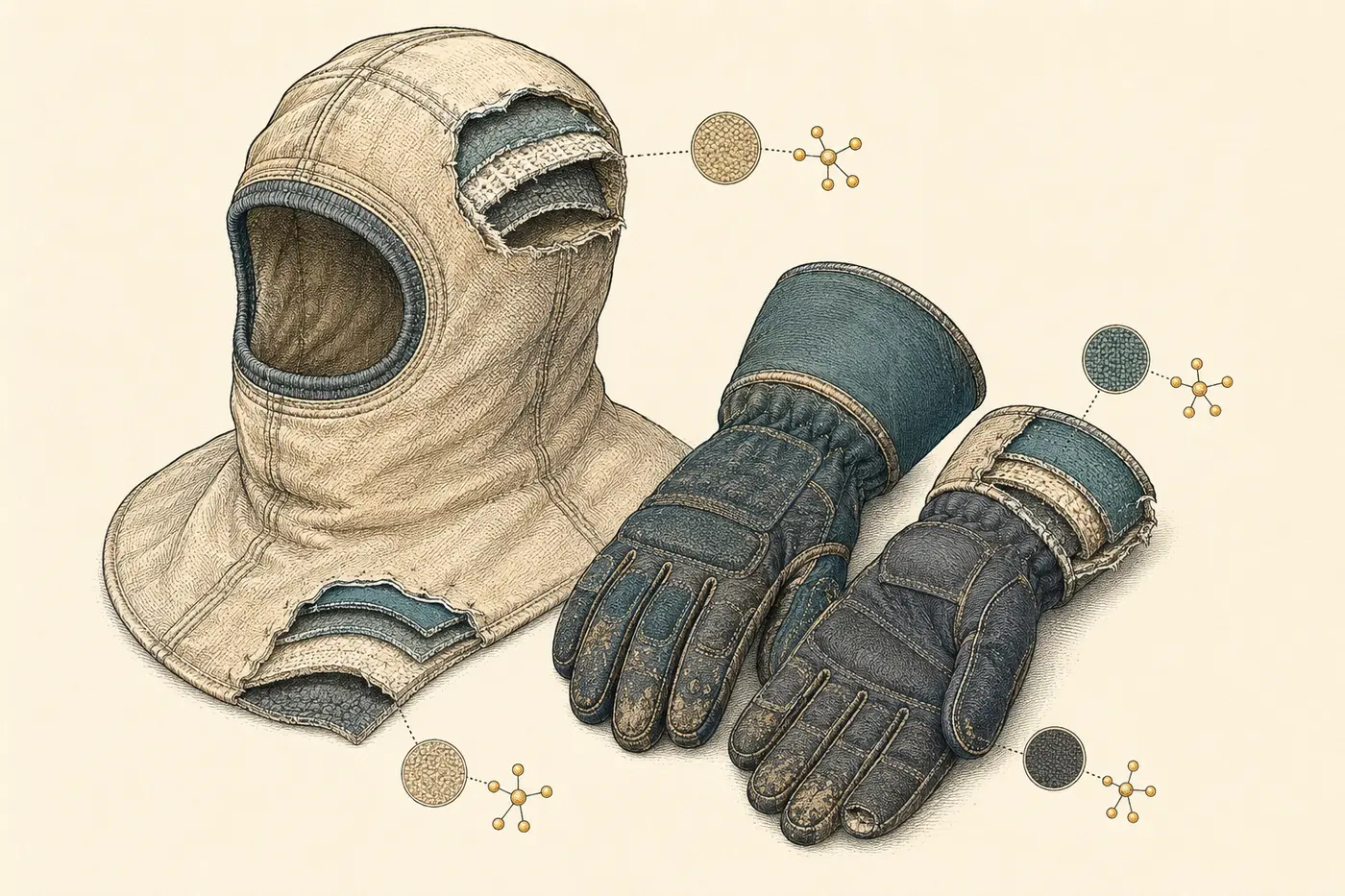
A conceptual view of protective-gear materials examined as researchers compared measurable PFAS under different wear conditions.
Reading boundary: The artwork represents material testing, not PFAS entering a firefighter's body, and it does not depict a measured exposure dose or health outcome.The research question and why it matters
NIST examined whether normal wear changes detectable PFAS in firefighter protective hoods and gloves.
PFAS have been detected in some firefighter protective materials, creating questions about performance, exposure and safer alternatives.
What the researchers needed to distinguish: whether the reported pattern or intervention could be demonstrated with the stated design and measurements—not whether every broader explanation or future application was already established.
What researchers found
The quantity and pattern of measurable PFAS differed with wear and material condition.
The safest conclusion is limited to the research subject (laboratory), the design (materials testing report) and the measured evidence base described above. Broader claims require additional studies that test different populations, settings, methods or assumptions.
How the research worked
Researchers compared chemical measurements across gear with different wear histories and material conditions using a documented federal test protocol.
How to interpret this design
The design determines what kind of conclusion the evidence can support. Direct measurement strengthens the reported observation, while generalization beyond the tested subjects, material, place or conditions requires additional evidence.
The reported evidence base was New and worn firefighter hoods and gloves tested with chemical measurements. Sample size matters, but it must be read together with who was included, how outcomes were measured, missing data, comparison conditions and the size of the observed effect.
The evidence comes from a controlled physical or chemical system. That control helps establish what happened under the tested conditions, while scale-up, durability, manufacturing and real-world performance remain separate questions.
How strong is the evidence?
Direct laboratory measurements support the narrow finding about tested gear, but they do not measure how much PFAS entered firefighters' bodies.
The result is meaningfully informative, but identifiable limitations could alter the size, reach or causal interpretation of the finding.
Funding and disclosure context
The recorded funding source is: U.S. government research; see NIST Technical Note 2375. The recorded conflict information is: See the technical report. Funding or a disclosed relationship does not by itself invalidate a result, but it is relevant when judging design choices, analysis and the need for independent replication.
What it means
Gear age and condition should be considered when interpreting chemical tests and designing exposure studies or replacement policies.
The finding is most useful when kept at the scale actually tested. It may change how researchers frame the next experiment, trial, observation or analysis even when it is not yet sufficient to change practice or establish a universal explanation.
What it does NOT prove
- It does not quantify a firefighter's absorbed dose.
- It does not show that all protective gear contains the same PFAS profile.
- It does not by itself establish a health risk threshold.
Important limitations
- Laboratory extraction is not the same as real-world skin or inhalation exposure.
- The tested products may not represent every manufacturer or gear generation.
- Wear histories can vary.
How this fits with previous research
PFAS have been detected in some firefighter protective materials, creating questions about performance, exposure and safer alternatives.
Consistency with earlier work can increase confidence, while a disagreement can expose a difference in population, measurement, model assumptions or study quality. Either way, one publication should be interpreted as part of a developing evidence record rather than as the final word.
Questions still unanswered
- How much transfers during actual use?
- Which materials reduce both exposure and heat risk?
- How should gear be monitored over its service life?
Relevant U.S. government resources
These resources serve different purposes. A registry can verify what researchers planned, a repository can locate government-funded work, and an agency page can supply authoritative background. None automatically proves that this paper's conclusion is correct.
PubMed record search ↗
Federal biomedical-index search keyed to this paper's DOI or title. It can confirm indexing and expose linked identifiers when a record is available; the journal paper remains the primary source.
Understanding clinical research ↗
NIH background on how clinical research is designed, reviewed and interpreted. This is contextual guidance, not independent confirmation of the study's result.
Reuse note: Facts and discoveries are summarized here in original language. We link to government material instead of copying it wholesale, and we do not reuse agency logos, photographs, charts or third-party material unless the specific reuse rights are verified.
Wear and tear changed measurable PFAS levels in firefighter hoods and gloves
This review was developed from the source record below and, when separately available, the primary paper or government report. The summary and analysis on this page are original editorial writing.
- Source organization
- National Institute of Standards and Technology
- Source type
- U.S. government
- Authors
- NIST researchers listed in Technical Note 2375
- Journal / report
- NIST Technical Note 2375
- Publication date
- May 13, 2026
- DOI
- Not available
- PMID
- Not available
- Institution
- National Institute of Standards and Technology
- Funding
- U.S. government research; see NIST Technical Note 2375
- Conflicts
- See the technical report
- Open access
- Yes
- Reuse approach
- Facts summarized in original language; no source text or imagery reproduced.
Medical content is general science reporting, not individualized medical advice. Do not start, stop or change treatment based solely on this research summary.