The team sought to identify specific stretches of DNA inherited from populations for which no reference genome exists.
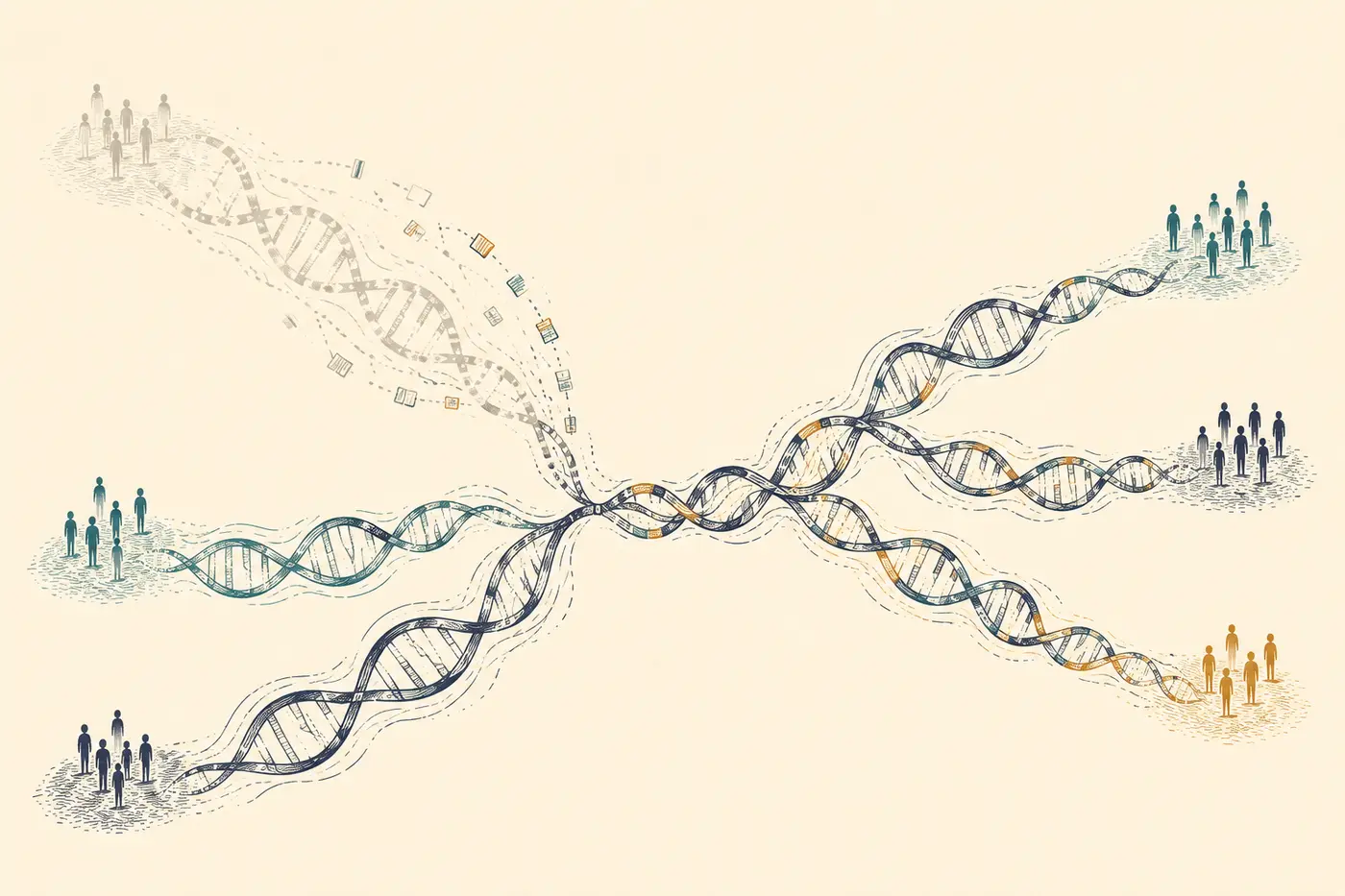
A conceptual view of genomic segments inherited from an ancestral population that has not yet been directly sampled.
Reading boundary: The unsampled population is a statistical inference, not a recovered individual, named culture or complete ancient genome.The research question and why it matters
The team sought to identify specific stretches of DNA inherited from populations for which no reference genome exists.
Geneticists have inferred ghost populations from mismatches between observed genomes and models, but localizing their DNA has been more difficult.
What the researchers needed to distinguish: whether the reported pattern or intervention could be demonstrated with the stated design and measurements—not whether every broader explanation or future application was already established.
What researchers found
The approach localized candidate segments from unsampled ancestral populations rather than only estimating an overall ghost-ancestry proportion.
The safest conclusion is limited to the research subject (computer model), the design (population-genetics method and simulation study) and the measured evidence base described above. Broader claims require additional studies that test different populations, settings, methods or assumptions.
How the research worked
Researchers modeled ancestry patterns, tested the method on simulated demographic histories and applied it to genomic datasets with complex admixture.
How to interpret this design
The design determines what kind of conclusion the evidence can support. Direct measurement strengthens the reported observation, while generalization beyond the tested subjects, material, place or conditions requires additional evidence.
The reported evidence base was Modern and ancient genome datasets plus simulated admixture histories. Sample size matters, but it must be read together with who was included, how outcomes were measured, missing data, comparison conditions and the size of the observed effect.
The evidence is produced by computation rather than direct experimental manipulation of the target system. Its value depends on transparent assumptions, realistic inputs, sensitivity testing and comparison with independent observations.
How strong is the evidence?
Simulation and known-case tests can validate recovery under specified histories, but unidentified ancestral populations remain statistical inferences without direct DNA.
The result explores a plausible explanation or scenario. Its reliability is conditional on assumptions and should be tested against new observations or experiments.
Funding and disclosure context
The recorded funding source is: See the paper. The recorded conflict information is: See the paper. Funding or a disclosed relationship does not by itself invalidate a result, but it is relevant when judging design choices, analysis and the need for independent replication.
What it means
Segment-level maps can help test when and where ancient populations mixed and whether inherited variants affect present-day biology.
The finding is most useful when kept at the scale actually tested. It may change how researchers frame the next experiment, trial, observation or analysis even when it is not yet sufficient to change practice or establish a universal explanation.
What it does NOT prove
- It does not identify the name, culture or exact location of an unsampled population.
- It does not turn a statistical ancestor into a recovered fossil genome.
- It does not make every candidate segment certain.
Important limitations
- Results depend on demographic assumptions and reference populations.
- Later recombination erodes ancestry signals.
- Population labels are models, not simple biological categories.
How this fits with previous research
Geneticists have inferred ghost populations from mismatches between observed genomes and models, but localizing their DNA has been more difficult.
Consistency with earlier work can increase confidence, while a disagreement can expose a difference in population, measurement, model assumptions or study quality. Either way, one publication should be interpreted as part of a developing evidence record rather than as the final word.
Questions still unanswered
- How robust is the method to incorrect demographic models?
- Can future ancient genomes confirm the segments?
- Which inferred variants influenced adaptation or disease?
Relevant U.S. government resources
These resources serve different purposes. A registry can verify what researchers planned, a repository can locate government-funded work, and an agency page can supply authoritative background. None automatically proves that this paper's conclusion is correct.
Federal archaeology resources ↗
Federal archaeology standards and background help frame preservation, provenance and interpretation. They are not evidence for the specific ancient-DNA or fossil result unless directly cited by the research.
Reuse note: Facts and discoveries are summarized here in original language. We link to government material instead of copying it wholesale, and we do not reuse agency logos, photographs, charts or third-party material unless the specific reuse rights are verified.
A new method pinpointed DNA inherited from unidentified ‘ghost’ ancestors
This review was developed from the source record below and, when separately available, the primary paper or government report. The summary and analysis on this page are original editorial writing.
- Source organization
- University of California, Berkeley
- Source type
- University
- Authors
- Authors listed in the linked research paper
- Journal / report
- Journal listed by UC Berkeley
- Publication date
- July 30, 2026
- DOI
- Not available
- PMID
- Not available
- Institution
- University of California, Berkeley and collaborators
- Funding
- See the paper
- Conflicts
- See the paper
- Open access
- Unclear
- Reuse approach
- Facts summarized in original language; no source text or imagery reproduced.