The Curiosity team investigated an extensive terrain of repeating polygonal, honeycomb-like textures on Mars.
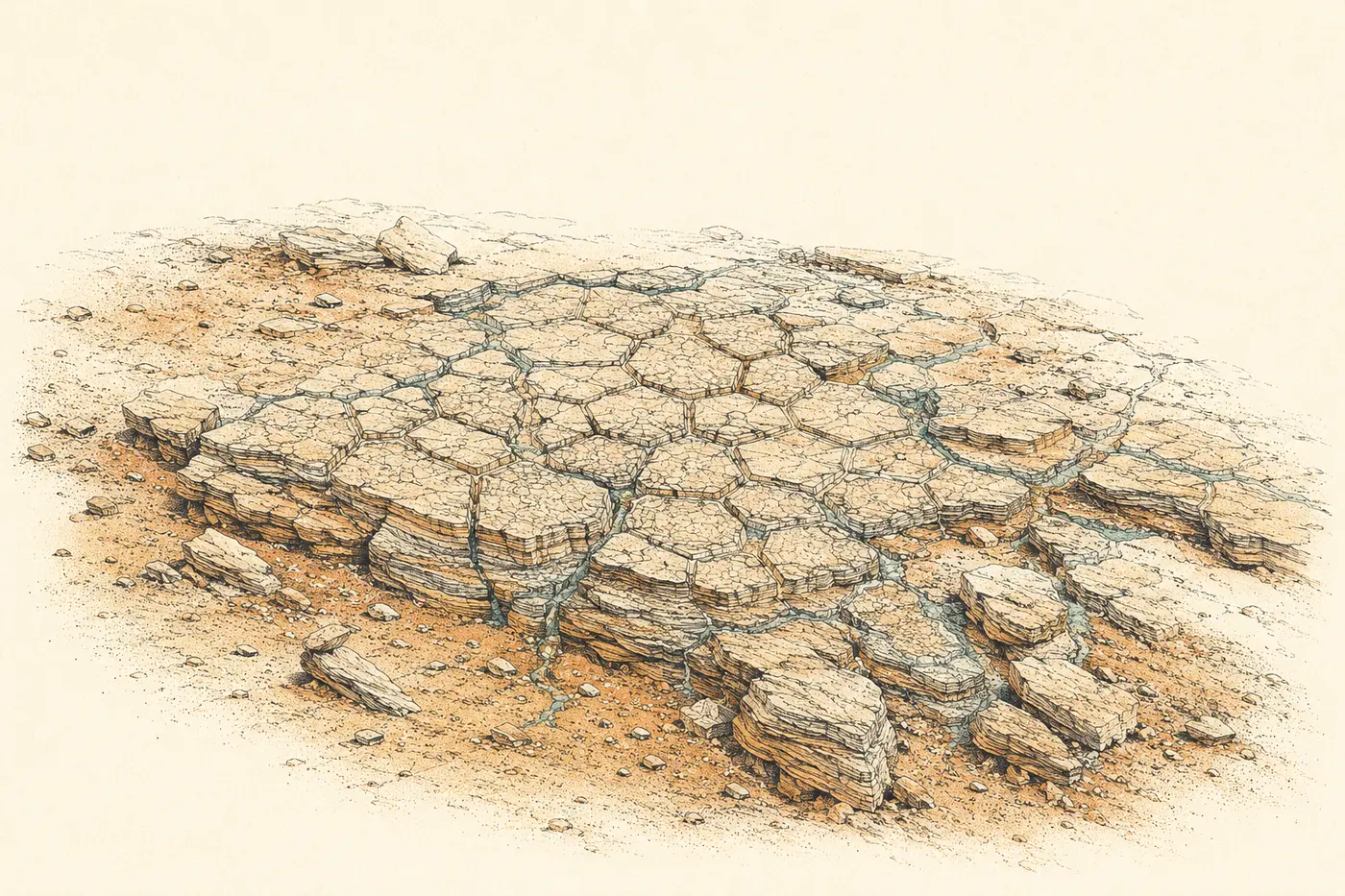
A conceptual view of the repeating polygonal textures observed by Curiosity and the ancient rock alteration scientists are investigating.
Reading boundary: The geometry is based on the reported observation; the past movement of fluids is an interpretation, not a scene directly witnessed by the rover.The research question and why it matters
The Curiosity team investigated an extensive terrain of repeating polygonal, honeycomb-like textures on Mars.
Curiosity has previously found veins, sedimentary structures and minerals that record ancient water-rock interactions in Gale crater.
What the researchers needed to distinguish: whether the reported pattern or intervention could be demonstrated with the stated design and measurements—not whether every broader explanation or future application was already established.
What researchers found
The rover observed a coherent field of polygonal textures consistent with repeated cracking and mineral alteration, potentially involving past fluids.
The safest conclusion is limited to the research subject (astronomical observation), the design (rover imaging and geological analysis) and the measured evidence base described above. Broader claims require additional studies that test different populations, settings, methods or assumptions.
How the research worked
Rover cameras and instruments documented shape, scale, composition and surrounding geology so scientists could compare competing formation mechanisms.
How to interpret this design
The design determines what kind of conclusion the evidence can support. Direct measurement strengthens the reported observation, while generalization beyond the tested subjects, material, place or conditions requires additional evidence.
The reported evidence base was Curiosity rover images and measurements from a Martian terrain field. Sample size matters, but it must be read together with who was included, how outcomes were measured, missing data, comparison conditions and the size of the observed effect.
Astronomers cannot manipulate the object experimentally, so the conclusion comes from measured light, motion or other signals interpreted through physical models. Alternative explanations and instrument limits therefore matter.
How strong is the evidence?
The geometry is directly imaged, but its formation history is inferred from morphology and geological context.
This is an early signal that deserves attention and replication, not a result that should yet carry the weight of mature, independently confirmed evidence.
Funding and disclosure context
The recorded funding source is: NASA mission. The recorded conflict information is: Not applicable to the mission report. Funding or a disclosed relationship does not by itself invalidate a result, but it is relevant when judging design choices, analysis and the need for independent replication.
What it means
The site offers another physical record of how water or other fluids may have moved through ancient Martian rock.
The finding is most useful when kept at the scale actually tested. It may change how researchers frame the next experiment, trial, observation or analysis even when it is not yet sufficient to change practice or establish a universal explanation.
What it does NOT prove
- It does not prove Mars once hosted life.
- It does not uniquely identify the fluid or exact formation process.
- It does not show that liquid water exists there today.
Important limitations
- Rover measurements cover a limited area.
- Different geological processes can create similar polygons.
- Laboratory analogs cannot reproduce every Martian condition.
How this fits with previous research
Curiosity has previously found veins, sedimentary structures and minerals that record ancient water-rock interactions in Gale crater.
Consistency with earlier work can increase confidence, while a disagreement can expose a difference in population, measurement, model assumptions or study quality. Either way, one publication should be interpreted as part of a developing evidence record rather than as the final word.
Questions still unanswered
- Which minerals line the structures?
- When did they form relative to surrounding layers?
- Do similar fields occur elsewhere on Mars?
Relevant U.S. government resources
These resources serve different purposes. A registry can verify what researchers planned, a repository can locate government-funded work, and an agency page can supply authoritative background. None automatically proves that this paper's conclusion is correct.
NASA Technical Reports Server search ↗
NASA's technical-information repository search for related reports and mission documentation. A repository match can add technical context but does not replace the cited paper.
Reuse note: Facts and discoveries are summarized here in original language. We link to government material instead of copying it wholesale, and we do not reuse agency logos, photographs, charts or third-party material unless the specific reuse rights are verified.
Curiosity found a field of honeycomb-like textures on Mars
This review was developed from the source record below and, when separately available, the primary paper or government report. The summary and analysis on this page are original editorial writing.
- Source organization
- NASA
- Source type
- U.S. government
- Authors
- NASA Curiosity science team
- Journal / report
- NASA mission observation
- Publication date
- July 29, 2026
- DOI
- Not available
- PMID
- Not available
- Institution
- NASA Jet Propulsion Laboratory and mission partners
- Funding
- NASA mission
- Conflicts
- Not applicable to the mission report
- Open access
- Yes
- Reuse approach
- Facts summarized in original language; no source text or imagery reproduced.