Researchers tested whether the sequence of Siberian Traps volcanism and environmental disruption aligns with the end-Permian extinction.
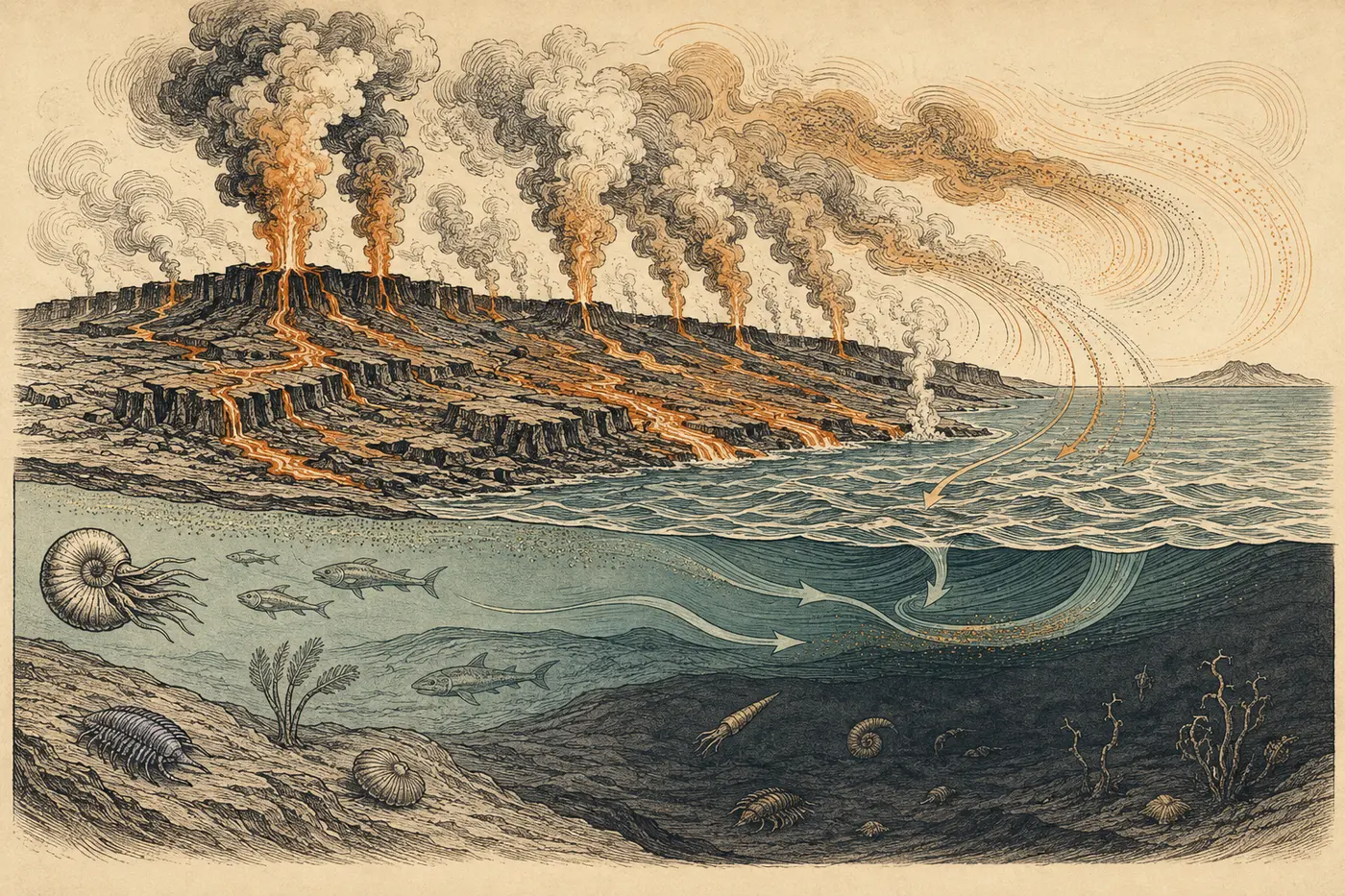
A conceptual deep-time sequence connecting sustained Siberian volcanism with atmospheric and ocean changes investigated in the end-Permian record.
Reading boundary: This is a reconstruction, not a witnessed scene or direct forecast of modern climate change; several linked stresses likely acted together.The research question and why it matters
Researchers tested whether the sequence of Siberian Traps volcanism and environmental disruption aligns with the end-Permian extinction.
Siberian Traps eruptions have long been the leading explanation for the end-Permian extinction, supported by timing and carbon-cycle disruption.
What the researchers needed to distinguish: whether the reported pattern or intervention could be demonstrated with the stated design and measurements—not whether every broader explanation or future application was already established.
What researchers found
The chronology and chemical evidence strengthened the case that volcanic carbon and associated environmental changes drove the extinction crisis.
The safest conclusion is limited to the research subject (archaeological material), the design (geochemical and geological reconstruction) and the measured evidence base described above. Broader claims require additional studies that test different populations, settings, methods or assumptions.
How the research worked
The team combined dated rock records and geochemical indicators of volcanic emissions, ocean change and biological loss.
How to interpret this design
The design determines what kind of conclusion the evidence can support. Direct measurement strengthens the reported observation, while generalization beyond the tested subjects, material, place or conditions requires additional evidence.
The reported evidence base was Rock and geochemical records spanning the end-Permian extinction. Sample size matters, but it must be read together with who was included, how outcomes were measured, missing data, comparison conditions and the size of the observed effect.
The conclusion is drawn from preserved material and its context. Dating, contamination control, site history, sample preservation and representativeness determine how far the interpretation can extend.
How strong is the evidence?
Independent geological proxies and dating constrain timing and mechanism, but deep-time records are incomplete and causal chains remain reconstructed rather than observed.
The result is meaningfully informative, but identifiable limitations could alter the size, reach or causal interpretation of the finding.
Funding and disclosure context
The recorded funding source is: See the paper. The recorded conflict information is: See the paper. Funding or a disclosed relationship does not by itself invalidate a result, but it is relevant when judging design choices, analysis and the need for independent replication.
What it means
The work refines how rapid greenhouse-gas release can cascade through climate and ocean systems at planetary scale.
The finding is most useful when kept at the scale actually tested. It may change how researchers frame the next experiment, trial, observation or analysis even when it is not yet sufficient to change practice or establish a universal explanation.
What it does NOT prove
- It does not make the end-Permian world a direct forecast of modern change.
- It does not exclude every contributing stressor.
- It does not recover a complete global record.
Important limitations
- Rock records contain gaps and regional biases.
- Dating and proxy interpretation carry uncertainty.
- Several linked mechanisms may have acted together.
How this fits with previous research
Siberian Traps eruptions have long been the leading explanation for the end-Permian extinction, supported by timing and carbon-cycle disruption.
Consistency with earlier work can increase confidence, while a disagreement can expose a difference in population, measurement, model assumptions or study quality. Either way, one publication should be interpreted as part of a developing evidence record rather than as the final word.
Questions still unanswered
- Which emission pulses caused the greatest ecological damage?
- How rapidly did different ecosystems collapse and recover?
- How did ocean deoxygenation and acidification interact?
Relevant U.S. government resources
These resources serve different purposes. A registry can verify what researchers planned, a repository can locate government-funded work, and an agency page can supply authoritative background. None automatically proves that this paper's conclusion is correct.
USGS Publications Warehouse ↗
The authoritative catalog of USGS scientific publications, used to check related government research and long-term observational context.
NOAA research and data ↗
Federal observations and research on climate, oceans, atmosphere and ecosystems provide context for environmental claims. They do not automatically validate a separate model or paper.
Reuse note: Facts and discoveries are summarized here in original language. We link to government material instead of copying it wholesale, and we do not reuse agency logos, photographs, charts or third-party material unless the specific reuse rights are verified.
New evidence strengthens the link between Siberian volcanism and Earth’s largest mass extinction
This review was developed from the source record below and, when separately available, the primary paper or government report. The summary and analysis on this page are original editorial writing.
- Source organization
- Stanford University
- Source type
- University
- Authors
- Authors listed in the PNAS paper
- Journal / report
- Proceedings of the National Academy of Sciences
- Publication date
- July 6, 2026
- DOI
- Not available
- PMID
- Not available
- Institution
- Stanford University and collaborators
- Funding
- See the paper
- Conflicts
- See the paper
- Open access
- Unclear
- Reuse approach
- Facts summarized in original language; no source text or imagery reproduced.